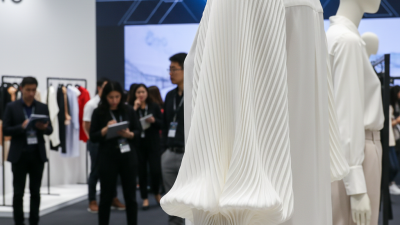
Top Flared Pleated Trousers Manufacturers for Global Buyers
Finding reliable Flared Pleated Trousers manufacturers requires more than comparing online catalogs. Global buyers need dependable construction, clear communication, and evidence of consistent production. This guide introduces manufacturers that may support private-label, wholesale, and international fashion programs.
Experienced sourcing teams usually examine fabric behavior before placing large orders. Pleats should recover after movement, while the flare must fall evenly from hip to hem. Small details matter. Uneven stitching can distort the silhouette under retail lighting. A practical evaluation includes sample reviews, measurement checks, fabric composition, colorfastness testing, and inspection of waistband strength. These steps reveal more than polished product photographs.
Supplier credibility also depends on transparent business practices. Buyers should request factory profiles, production capacity, export experience, and relevant quality documentation. Certifications can be useful, but they should be verified for scope and validity. Sustainable claims require evidence, not attractive wording. That point is easy to overlook.
Manufacturers differ in minimum order quantities, sampling fees, lead times, customization options, and packaging support. A factory producing basic trousers may not handle complex pleating accurately. Another supplier may offer excellent tailoring but limited seasonal capacity. Neither is automatically the best choice. Fit your selection to the collection, budget, and delivery schedule.
This overview is designed for informed comparison, not blind purchasing. Market conditions change, and supplier performance can vary between orders. Buyers should confirm current terms directly and document every specification. A careful process protects quality, timelines, and brand reputation while creating stronger long-term manufacturing relationships.
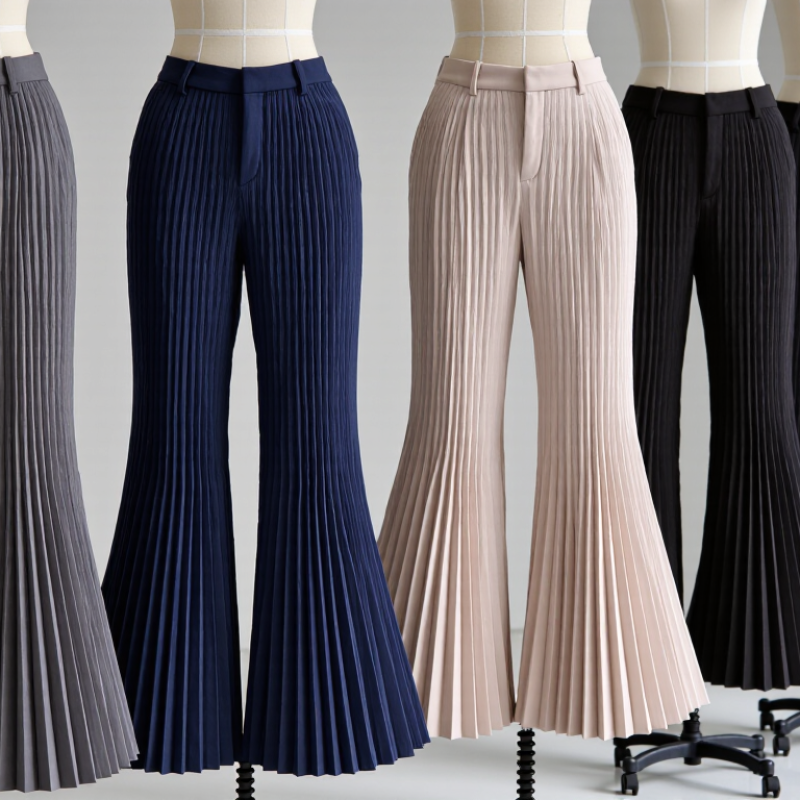
Product Definition: Flared Pleats, Fabric Weight, Fit, and Construction
For global buyers, flared pleated trousers need more than a wide hem. Flared pleats begin at the waist or hip and open gradually toward the ankle. This creates movement without making the garment look oversized. A practical sample should show clean pleat recovery after sitting. It should not collapse into sharp, permanent wrinkles.
Fabric weight strongly affects the silhouette. Lightweight cloth, around 120–180 g/m², gives softer motion but may reveal pocket outlines. Midweight fabric, around 200–280 g/m², supports deeper pleats and steadier flare. ASTM D3776 provides a recognized method for measuring fabric mass. Buyers should request test results, not rely on labels alone.
Textile Exchange’s 2024 Materials Market Report estimated global fiber production at 124 million tonnes in 2023, with polyester representing about 57%. That scale makes fiber selection and recycled-content verification commercially important.
Fit approval should include waist, hip, thigh, rise, inseam, and hem opening measurements. A 32-centimeter hem can appear modest on one block and dramatic on another. Construction details matter. Stable waistband fusing, reinforced pocket corners, and evenly pressed pleat edges reduce distortion during wear.
ASTM D1683 can support seam-strength evaluation for woven garments. Still, one fitting model is not enough. Different body proportions can expose drag lines near the fly or seat.
Some prototypes will fail. That is useful evidence, not wasted sampling.
Material Benchmark: Polyester Represented 57% of Global Fiber Output in 2023
For global buyers, polyester is more than a low-cost option in flared pleated trousers. It represented about 57% of global fiber output in 2023, according to widely cited textile industry estimates. That figure signals scale, not automatic quality. Fiber-output statistics may use different boundaries, so buyers should check the original methodology. Still, polyester offers stable pleat retention, quick drying, and predictable bulk production. A finished trouser can leave a pressing line with sharper folds and fewer size-to-size surprises.
Experienced sourcing teams should assess yarn type, fabric weight, and heat-setting controls before comparing quotations. A 180–240 gsm polyester fabric may suit lightweight fashion trousers, while heavier constructions provide stronger drape. Ask manufacturers for wash tests, seam-slippage results, colorfastness reports, and recycled-content documentation where relevant. Inspect the waistband, hem, and pleat apex. These areas expose weak construction quickly. Sample garments should be measured after washing, not only straight from the factory.
Polyester also carries trade-offs. It can retain odor, create unwanted shine under harsh pressing, and contribute to microfiber release during washing. These risks deserve practical testing, not marketing language. I would avoid choosing a supplier from fiber percentage alone. Factory audit depth, process records, and correction speed matter just as much. The benchmark is useful, but incomplete. A better question is whether the manufacturer can control polyester consistently across color, size, and production volume.
Top Flared Pleated Trousers Manufacturers for Global Buyers - Material Benchmark: Polyester Represented 57% of Global Fiber Output in 2023
| Benchmark Category |
Material or Specification |
Typical Benchmark |
Application in Flared Pleated Trousers |
Buyer Verification Point |
| Global fiber output |
Polyester |
57% in 2023 |
High-volume option for durable, wrinkle-resistant trousers |
Confirm fiber content through supplier declaration or laboratory testing |
| Common natural fiber |
Cotton |
22% in 2023 |
Improves softness, breathability, and a natural hand feel |
Check origin, yarn quality, shrinkage, and blend percentage |
| Stretch construction |
Polyester with elastane |
2–8% elastane |
Supports movement while preserving the flared silhouette |
Test stretch recovery after repeated extension and laundering |
| Trouser fabric weight |
Woven suiting, twill, or crepe |
180–300 g/m² |
Balances drape, opacity, pleat definition, and seasonal comfort |
Approve fabric swatches and verify GSM before bulk production |
| Pleat structure |
Front pleats |
1–2 pleats per front |
Creates controlled fullness through the hip and upper leg |
Specify pleat depth, direction, stitch-down length, and tolerance |
| Flare profile |
Leg opening circumference |
Approx. 46–66 cm |
Defines the visual difference between bootcut and wide-flare styles |
Measure finished garment by size and maintain grading consistency |
| Dimensional stability |
Shrinkage after care |
Preferably ≤3% |
Helps preserve waist, inseam, flare, and pleat alignment |
Use a recognized laundering or dimensional-change test method |
| Colorfastness |
Color change and crocking resistance |
Target Grade 4 or above |
Reduces visible fading and color transfer during wear |
Request test results for dry rubbing, wet rubbing, washing, and perspiration |
| Seam durability |
Inseam, rise, waistband, and pocket seams |
Reinforced stress areas |
Supports wear resistance in high-load construction zones |
Inspect stitch density, bartacks, seam allowance, and breakage resistance |
| Compliance documentation |
Restricted substances and fiber claims |
Required before shipment |
Supports import, labeling, and responsible sourcing requirements |
Request transaction certificates, test reports, care labels, and country-specific documents |
Data note: The 2023 fiber-share figures are based on Textile Exchange’s Materials Market Report 2024. Product specification ranges are indicative sourcing benchmarks for global buyers and are not company-specific performance claims.
Manufacturer Evaluation: ISO 9001, OEKO-TEX, AQL 2.5, and Factory Capacity
Top Flared Pleated Trousers Manufacturers for Global Buyers
Manufacturer evaluation should begin with documented quality systems, not attractive samples. ISO 9001 certification indicates controlled processes, corrective actions, and traceable records. ISO’s 2023 Survey reports more than one million ISO 9001 certificates worldwide. The number is impressive, but certification alone proves little about trouser construction. Buyers should inspect pleat symmetry, waistband recovery, seam strength, and shrinkage after washing.
OEKO-TEX Standard 100 certification helps verify that tested textile components meet limits for harmful substances. Request the certificate scope, product class, expiry date, and matching fabric details. Textile Exchange’s 2024 Materials Market Report states that global fiber production reached about 124 million tonnes in 2023. This scale increases sourcing pressure and makes chemical traceability more important. Small oversights matter.
Use AQL 2.5 as an acceptance reference, not a promise of perfection. The sampling plan, lot size, inspection level, and defect classification must be written clearly. Check critical defects separately from minor measurement deviations. Factory capacity also needs evidence: monthly trouser output, cutting tables, sewing lines, peak-season utilization, and backup subcontracting controls. Capacity claims can be optimistic. A factory may quote 100,000 pieces monthly, yet lack pressing space for sharp flares and stable pleats. Ask for recent production records, line photographs, and an independent pre-shipment inspection. Even experienced buyers sometimes overlook carton storage and rework capacity. That mistake becomes expensive.
Buyer Due Diligence: Compliance, MOQ, Lead Time, Sampling, and Quality Control
Top Flared Pleated Trousers Manufacturers for Global Buyers
Buyer due diligence starts with compliance, not price. Request the factory’s legal registration, production address, subcontractor list, and recent audit reports. Check fiber content, colorfastness, shrinkage, azo dyes, and flammability against destination-market requirements. The OECD Due Diligence Guidance for Garment and Footwear Supply Chains recommends risk-based supplier monitoring. A certificate alone is not enough. Verify its scope and expiry date. ISO’s 2023 Survey recorded 1,265,216 ISO 9001 certificates worldwide, but certification does not guarantee trouser quality.
MOQ and lead time need written assumptions. Ask whether the MOQ applies per color, size range, or total order. Confirm fabric booking, pleat-setting capacity, inspection dates, and shipment terms. The WTO World Trade Statistical Review 2024 reported a 1.2% decline in global merchandise trade volume during 2023. Delays remain realistic. Build buffer time. Sampling should include a graded size set, wash test, measurement chart, and approved pre-production sample. One attractive sample proves little.
Tips: Compare at least three factories using the same tech pack. Require an inline inspection and a final AQL inspection. Record pleat depth, waistband recovery, seam strength, and pressing appearance. ISO 9001 is useful evidence, not a shortcut. An imperfect sample can reveal inconsistent fabric tension or weak construction. That feedback deserves documentation, not excuses. Examine corrective-action photos, then retest the revised sample before bulk production.